 We Boat Licence
Pass your boating-licence theory with confidence.
The complete, offline study companion for eleven European boating licences, each with mock exams scored the way yours really is.
We Boat Licence
The complete, offline study companion for eleven European boating licences, each with mock exams scored the way yours really is.
The complete, offline study companion for eleven European boating licences (the French permis côtier and permis fluvial, the Belgian restricted and general brevets, the Dutch Klein Vaarbewijs 1 and 2, the German Sportbootführerschein See, the Spanish PER and PNB, and the Italian patente nautica within 12 miles and with no limit) each with mock exams scored the way yours really is. 20 universal subjects plus your licence's own, 2000+ questions, first mock exam free, all in your pocket, offline. And it does not stop at the exam: a daily challenge and spaced repetition of your own mistakes keep the material alive once the licence is in your pocket, especially over winter, when you are not on the water.
A clear, native interface in light and dark mode, built to learn fast and remember longer.




↔ Swipe to see more.
Up to 487 lesson sheets and reference plates depending on your licence: 20 universal subjects, plus your licence's own.
Up to 72 configurations depending on the licence, each flashing its real character, seen from four angles and drawn on its own vessel's silhouette, plus day shapes and national lights.
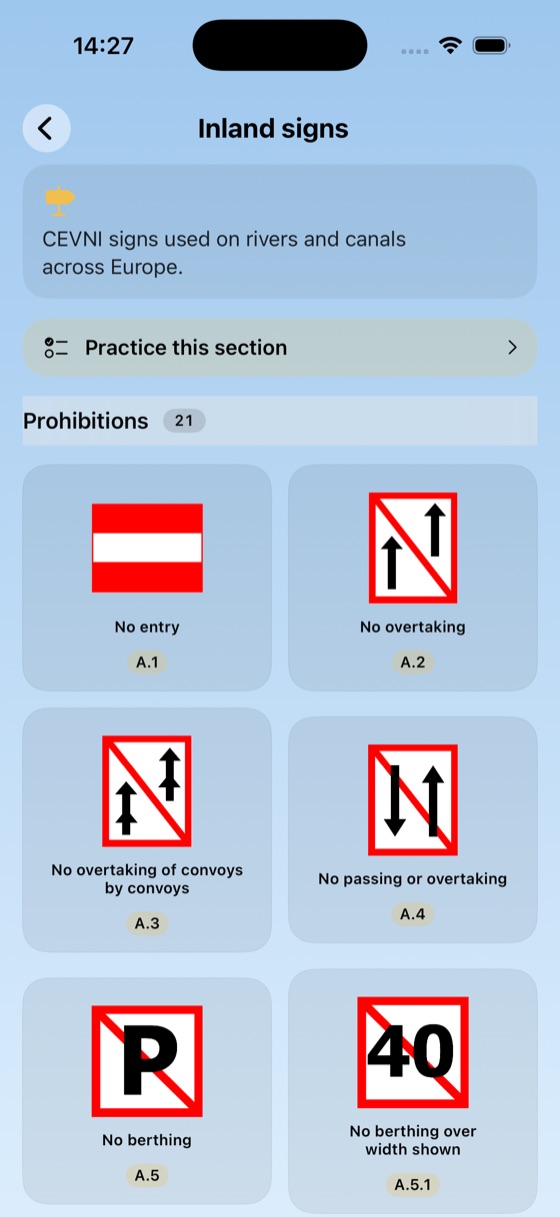
IALA-A cardinal/lateral marks and the official CEVNI inland signs, with the real regulatory imagery.
Steering & sailing rules and whistle/fog signals, illustrated with practical scenarios.
Channels, DSC/MMSI, MAYDAY/PAN-PAN, flares, EPIRB and the required safety equipment.
Plotting, Cv = Cc + d + D, Beaufort/Douglas, fronts, tides and currents.
Step-by-step knot diagrams, docking/anchoring/locks, and the MARPOL essentials.
We Boat Licence speaks your exam's language. Choose your licence on first launch and the app tailors its content and vocabulary: the Belgian brevet de conduite and inland RPNE/CEVNI rules, the French permis côtier and the Dutch vaarbewijs. Coastal and inland navigation, in one app, with the German Sportbootführerschein See, the Spanish PER and PNB and the Italian patente nautica covered too.
🇧🇪 Belgium · 🇫🇷 France · 🇳🇱 Netherlands · 🇩🇪 Germany · 🇪🇸 Spain · 🇮🇹 Italy
Over 2000 questions in seven formats, with diagrams, photos and instant explanations.
All 20 subjects and every practice quiz are free (supported by ads). We Boat Licence Pro is a single one-time purchase that removes ads and unlocks unlimited mock exams, progress statistics and the targeted review mode. No account, no subscription, works fully offline. Optional study reminders are opt-in and purely pedagogical, never marketing.
COLREG (IMO), IALA-A, CEVNI (UNECE) and the national regulations of France, Belgium and the Netherlands, verified and documented.
See all sources & compliance →We Boat Licence is deliberately narrow. Knowing what it does not do is the fastest way to know whether it is for you.
· Licence holders who want to keep what they learned. The rules fade once the exam is passed (lights, cardinal marks, right of way). A daily challenge and spaced repetition of your own mistakes keep them available, through the winter and into the next season.
· Candidates for the eleven European licences it prepares: the French permis côtier and permis fluvial, the Belgian restricted and general brevets, the Dutch Klein Vaarbewijs 1 and 2, the German Sportbootführerschein See, the Spanish PER and PNB, and the Italian patente nautica within 12 miles and with no limit.
· People revising on their own, between two lessons with an instructor, or after the course has ended.
· Anyone who needs to revise offline, with no account and no subscription.
· Replacing a course or practical training. It prepares the theory, and nothing else.
· Offshore sailing. No celestial navigation, no radar plotting, no secondary-port tidal calculation: the scope stops at the coastal level.
· Countries other than Belgium, France, the Netherlands, Germany, Spain and Italy. The international content (COLREG, IALA-A, CEVNI) is useful anywhere, but there is no national regulation module beyond those six.
· Telling you which licence to take, or how to enrol. It teaches the rules, not the administrative procedure.
Everything you need to know before you start studying.
Eleven, each with its own official mock-exam scoring: the French permis côtier and permis fluvial, the Belgian restricted and general brevets, the Dutch Klein Vaarbewijs 1 and 2, the German Sportbootführerschein See, the Spanish PER and PNB, and the Italian patente nautica within 12 miles and with no limit. Pick yours at first launch and the content, the vocabulary and the exam scoring all adapt. The COLREG, IALA-A and CEVNI content is international and shared by all of them.
Yes. All 20 subjects, 2000+ questions and the mock exam work fully offline: no account and no connection required.
Yes. All 20 subjects and every practice quiz are free, and your first mock exam is free too. We Boat Licence Pro is a single one-time purchase (€9.99) that removes ads and unlocks unlimited mock exams, statistics and the targeted review mode.
Over 2000 questions in seven formats, each with a short explanation, plus a realistic weighted mock exam that gives a pass/fail verdict and a per-category breakdown.
Yes. The content is built on official sources (COLREG, IALA-A, CEVNI and the national regulations of France, Belgium and the Netherlands), all verified and documented.
A North cardinal mark has two black cones both pointing upward and shows a continuous very quick or quick flashing white light. It means safe water lies to the north of the mark: steer to pass north of it to clear the danger it marks. (IALA-A buoyage system, Region A.)
A sailing vessel under 20 metres, when under sail alone (engine off) at night, may show a single tricolour lantern at the masthead combining red to port, green to starboard and white astern in one fixture, instead of separate sidelights and a stern light. It must switch back to separate lights as soon as the engine is used. (COLREG Rule 25(b).)
The overtaking vessel must always keep clear of the vessel being overtaken, and stays the give-way vessel until she is finally past and clear, even if the encounter later looks like a crossing situation. A vessel is 'overtaking' when approaching from more than 22.5° abaft the other vessel's beam, the sector where at night only her stern light is visible. (COLREG Rule 13.)
A blue cone (point down by day, replaced by a blue light at night) marks an inland vessel carrying dangerous goods under ADN rules: one, two or three cones show the danger category and how widely other vessels must keep clear. It's a different signal from the rectangular blue board used to indicate a course change during a passing manoeuvre. (CEVNI / ADN.)
A safe water mark has red-and-white vertical stripes and a single red spherical topmark, and its light (if fitted) shows a white isophase, occulting, or single long flash. It signals open, navigable water all around (for example a mid-channel or landfall point) and may be passed on either side. (IALA-A buoyage system.)
That is the need it was built for first. Once the exam is passed the rules fade (lights, cardinal marks, right of way) and they fade fastest over winter, when you are not on the water. The daily challenge, the quizzes and the spaced repetition of your own mistakes exist to keep that knowledge available, not just to get you through an exam. Everything works offline, which is what matters on board.
A real harbour, its real buoyage: put every missing mark back in place, then watch your boat sail in. Free, no sign-up, right in your browser.